In this story, Supergirl continues her efforts to find a solution for the problem of Kryptonite. She places a green K meteor in a cave and tries to approach it and marks where she first feels pain. The second day she goes a little closer, and then closer still, till it seems that she must have become immune to the stuff. However, when she attempts to save Superman from Kryptonite she also falls victim to the poisonous radiation. They save themselves by focusing their x-ray vision on some gold above the green K. The gold is transmuted into lead by the effect of their vision, covering the meteor. Later they discover the reason why the other Kryptonite meteor was becoming less painful to Supergirl was that a metal-eating beast was eating the meteor from the inside.
More about →
Supergirl--Action # 261
Người đăng: Unknown
This is a significant issue for the introduction of Streaky, the Supercat. Supergirl attempts to find a substance that will neutralize Kryptonite, but is unsuccessful. She throws the Kryptonite away, but Streaky, a stray cat that Supergirl (as Linda Lee) adopted, finds and plays with it. For some unexplained (in this story) reason, the Kryptonite gives the cat super-powers and he decides to use those powers for the good of downtrodden cats everywhere. But at the end of the story, Streaky loses his powers. Note: In this story the colorist screwed up and Supergirl is shown with a red skirt on her uniform, instead of blue.
More about →
Supergirl--Action # 260
Người đăng: Unknown on Thứ Ba, 4 tháng 10, 2005
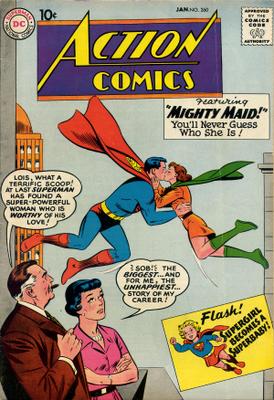
The Superman story qualifies as a fairly idiotic story in the Action Comics catalogue. Superman meets a super-powered woman and they apparently fall in love, much to the dismay of Lois Lane. But in the end it was all a trick to fool the invading aliens (like that never happened ten million times in the Silver Age).
Of course, in the end, the super-powered woman turns out to be Supergirl, which is rather embarrassing since the cover and one panel show Superman kissing her rather passionately:
The Supergirl feature itself is a rather pedestrian "turn into a baby" story that DC was fond of back in the 1960s. There are numerous ridiculous examples of this plot device. In this one, Supergirl (still operating secretly) saves an old man from drowning in an pool by pushing him out of the water and onto land. Of course, it turns out that the pool contains the legendary Fountain of Youth, and the old man becomes a young man, while Supergirl becomes a baby, in which guise she manages to get some crooks arrested.
More about →
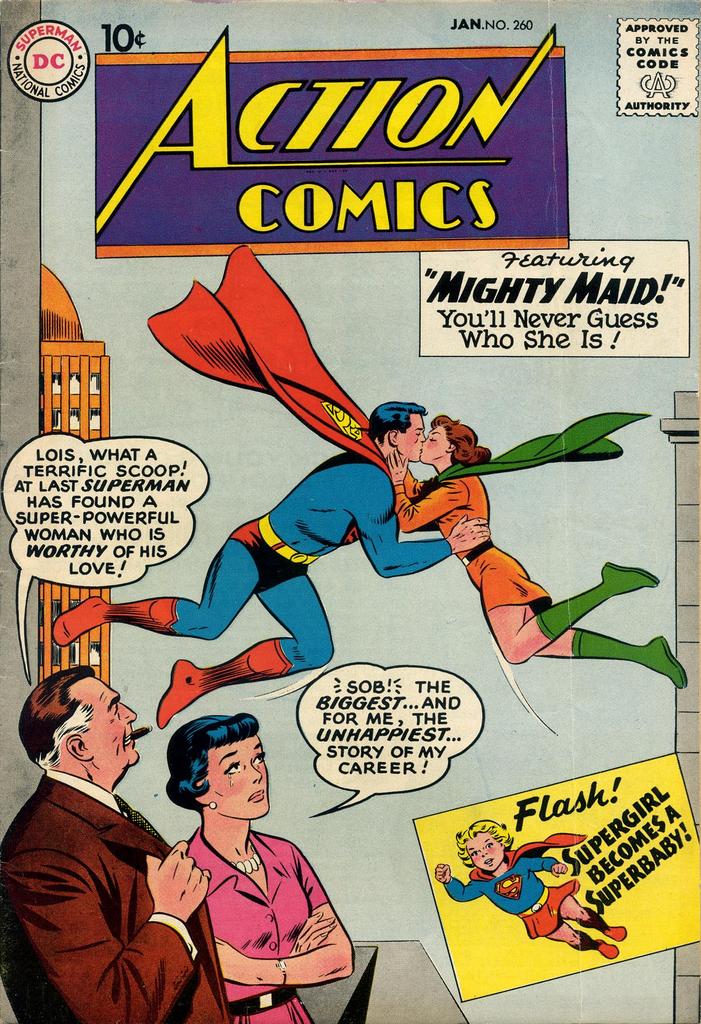
Of course, in the end, the super-powered woman turns out to be Supergirl, which is rather embarrassing since the cover and one panel show Superman kissing her rather passionately:
The Supergirl feature itself is a rather pedestrian "turn into a baby" story that DC was fond of back in the 1960s. There are numerous ridiculous examples of this plot device. In this one, Supergirl (still operating secretly) saves an old man from drowning in an pool by pushing him out of the water and onto land. Of course, it turns out that the pool contains the legendary Fountain of Youth, and the old man becomes a young man, while Supergirl becomes a baby, in which guise she manages to get some crooks arrested.
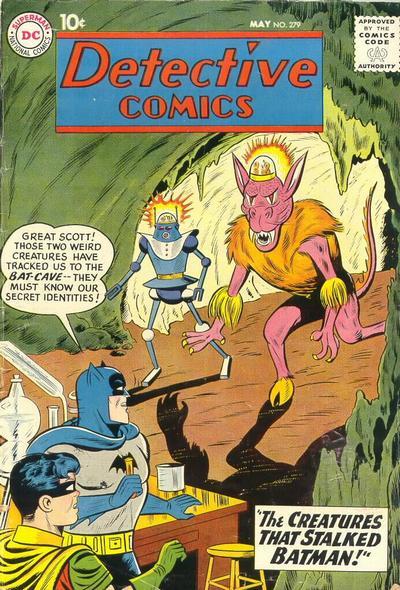
The Horrifying Batman Era in Covers--Detective
Người đăng: Unknown on Thứ Ba, 27 tháng 9, 2005
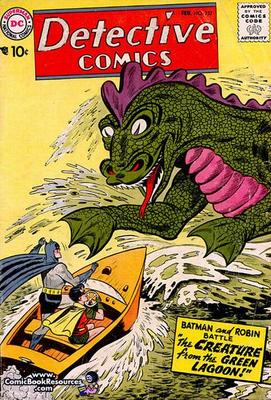
Creatures:


Weird Transformations:

Aliens

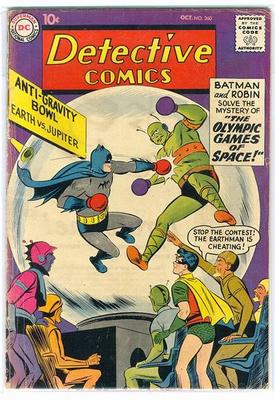
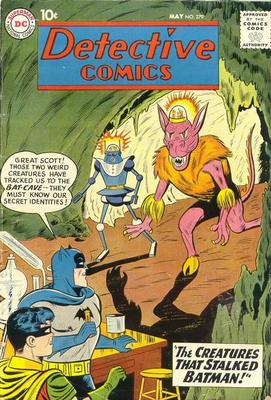
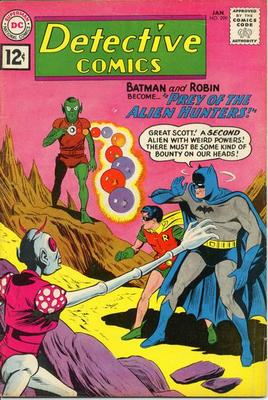
More about →


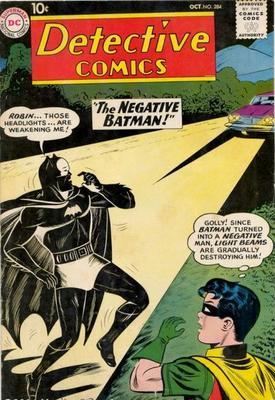
Weird Transformations:

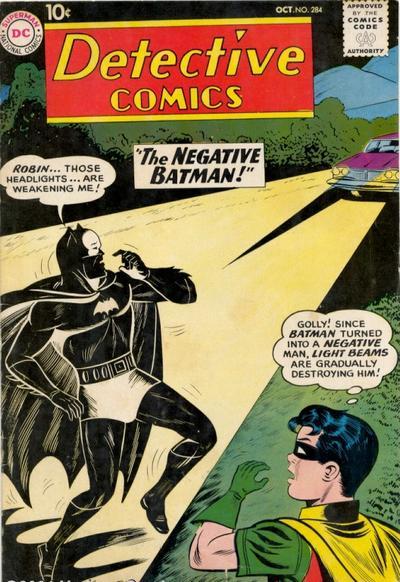
Aliens



Wonder Woman #17
Người đăng: Unknown on Thứ Năm, 15 tháng 9, 2005
Got the chance to read this Golden Ager today. Here are my observations:
The story is a long one, a three-parter concerning a woman too willing to trust her villainous fiancee. Dr Lana Curee has invented a cure for cancer, but unknown to her, it was given to a man who died. To save her from being prosecuted, her boyfriend, Carl Ambishun suggests that she sign over the right to her formula to him. Fortunately Wonder Woman intercedes by spilling ink on the contract. While Carl goes to get another copy, Etta and the Holliday Girls take Dr Curee to Mount Fate, where the Winds of Time will help her think more clearly.
The winds take them back to their previous lives (Shirley McLaine would love this) ancient Rome, and later to the Wild West. In each time period Dr Curee trusts an evil suitor and is betrayed, so when she makes it back to the present she realizes that Carl is trying to steal her formula and use it to make money.
More about →
The story is a long one, a three-parter concerning a woman too willing to trust her villainous fiancee. Dr Lana Curee has invented a cure for cancer, but unknown to her, it was given to a man who died. To save her from being prosecuted, her boyfriend, Carl Ambishun suggests that she sign over the right to her formula to him. Fortunately Wonder Woman intercedes by spilling ink on the contract. While Carl goes to get another copy, Etta and the Holliday Girls take Dr Curee to Mount Fate, where the Winds of Time will help her think more clearly.
The winds take them back to their previous lives (Shirley McLaine would love this) ancient Rome, and later to the Wild West. In each time period Dr Curee trusts an evil suitor and is betrayed, so when she makes it back to the present she realizes that Carl is trying to steal her formula and use it to make money.
Supergirl--1959
Người đăng: Unknown on Chủ Nhật, 28 tháng 8, 2005
Appearances: Action #252-259, Superman #130, Jimmy Olsen #40
Supergirl arrived on Earth in Action Comics #252 (May 1959), apparently following a successful tryout in Superman #123 (August 1958), although the concept of a Supergirl or Superwoman had appeared quite often in the Superman chronicles.
The new Supergirl was Kara Zor-El, Superman's young cousin on his father's side. Her family had been flung into space with the rest of Argo City when Krypton exploded and had survived for years thanks to Zor-El's lining the Kryptonite core of the planetoid with lead to protect the inhabitants. Unfortunately a meteor shower pierced the shields. Before dying (apparently) Zor-El had sent his only daughter, by then a teenager, into space much as his brother had done the same for his only son.
Superman is happy to welcome his only kin to survive Krypton's explosion, but because his identity as Clark Kent must not be divulged, he can't allow her to live with him. So he drops her off at the Midvale Orphanage, where he tells her to keep her super powers secret. She assumes the identity of Linda Lee, a young survivor of a catastrophe that wiped out her town.
At first Supergirl uses her powers in secret to try to help people, sometimes with bad results. For instance, in Action #253 after a farm couple are refused to be allowed to adopt a young farmboy due to poverty, she creates a tourist attraction on the farm which makes them wealthy. Unfortunately, they then decide to move to the city and reason that a farm lad might not suit them, so Supergirl has to go to further extremes to try to make the adoption work.
Supergirl's first major love interest arrives in Action #255 in the person of Dick Wilson (later Malverne). In this story he's mostly played as a secret identity pest a la Lois Lane.
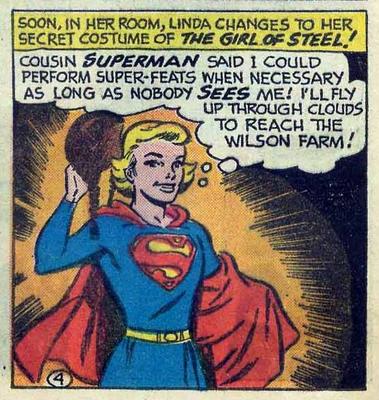
Supergirl's appearance changed a bit over the years. Here's how she looked in the first few issues:
She looked a little different in her appearance in Jimmy Olsen #40.
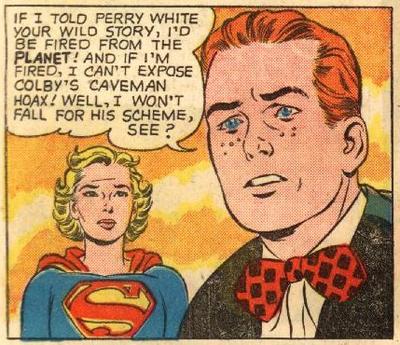
Rather flat-chested in both, but that would change. The Jimmy Olsen story is played for laughs. Because Superman is busy, Supergirl takes it upon herself to rescue Olsen when he sounds the alarm on his signal watch. She divulges her indentity as Superman's cousin, but temporarily blinded by tear gas, he refuses to believe a Supergirl really exists.
Her appearance in Superman #130 is simply a cameo.
More about →
Supergirl arrived on Earth in Action Comics #252 (May 1959), apparently following a successful tryout in Superman #123 (August 1958), although the concept of a Supergirl or Superwoman had appeared quite often in the Superman chronicles.
The new Supergirl was Kara Zor-El, Superman's young cousin on his father's side. Her family had been flung into space with the rest of Argo City when Krypton exploded and had survived for years thanks to Zor-El's lining the Kryptonite core of the planetoid with lead to protect the inhabitants. Unfortunately a meteor shower pierced the shields. Before dying (apparently) Zor-El had sent his only daughter, by then a teenager, into space much as his brother had done the same for his only son.
Superman is happy to welcome his only kin to survive Krypton's explosion, but because his identity as Clark Kent must not be divulged, he can't allow her to live with him. So he drops her off at the Midvale Orphanage, where he tells her to keep her super powers secret. She assumes the identity of Linda Lee, a young survivor of a catastrophe that wiped out her town.
At first Supergirl uses her powers in secret to try to help people, sometimes with bad results. For instance, in Action #253 after a farm couple are refused to be allowed to adopt a young farmboy due to poverty, she creates a tourist attraction on the farm which makes them wealthy. Unfortunately, they then decide to move to the city and reason that a farm lad might not suit them, so Supergirl has to go to further extremes to try to make the adoption work.
Supergirl's first major love interest arrives in Action #255 in the person of Dick Wilson (later Malverne). In this story he's mostly played as a secret identity pest a la Lois Lane.
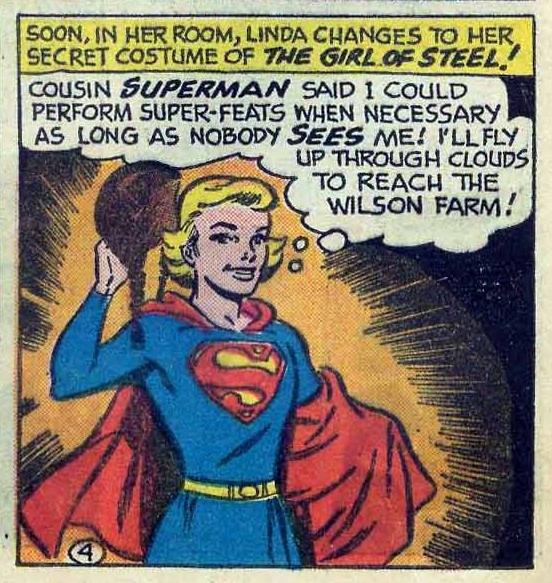
Supergirl's appearance changed a bit over the years. Here's how she looked in the first few issues:
She looked a little different in her appearance in Jimmy Olsen #40.

Rather flat-chested in both, but that would change. The Jimmy Olsen story is played for laughs. Because Superman is busy, Supergirl takes it upon herself to rescue Olsen when he sounds the alarm on his signal watch. She divulges her indentity as Superman's cousin, but temporarily blinded by tear gas, he refuses to believe a Supergirl really exists.
Her appearance in Superman #130 is simply a cameo.
Batman 1957
Người đăng: Unknown
Issues Covered: Batman #105-112, Detective 239-250.
Significant Stories: In Detective #244, we are introduced to the man who gave Batman his first Batarang and taught him how to throw it. Lee Collins was an Australian with a sideshow act throwing boomerangs. This makes the third story in as many years about the people who trained Batman in the skills he uses.
Detective #243 continues the weird transformation trend that started with #218, this time featuring The Giant Batman. Robin changes into a man again briefly in Batman #107's The Grown-Up Boy Wonder. It was still only a trickle at the time, but that was about to change.
Another trend that would prove irresistible to Batman writers began with a vengeance in Detective #250: Aliens. Batman had occasionally bumped into extraterrestials (e.g., The Manhunter from Mars, a J'onn J'onzz prototype, in Batman #78), but he was about to be inundated with them.
Batwoman returns in Batman #105. Kathy Kane had worn her old costume to a masquerade ball, but ended up helping Robin. Batman has apparently suffered amnesia, so she comes out of retirement to help the Boy Wonder. She retires again after this story, but in World's Finest #90's The Super Batwoman, Batman relents and decides to allow her to fight crime. She returns for the third time that year in Detective #249, The Execution of Bruce Wayne.
In The Secret of Batman's Butler, from Batman an early attempt at retconning is made. Alfred simply applied for the job of butler to Wayne Manor; there was no discussion about his father having worked for Thomas Wayne. In addition, he learns about Bruce's double life when Batman is injured and Robin calls him down to the Batcave. This is all wildly inconsisted with the original Alfred story in Batman #16, and most subsequent retellings (the most recent ones have him working for the Waynes before the murders).
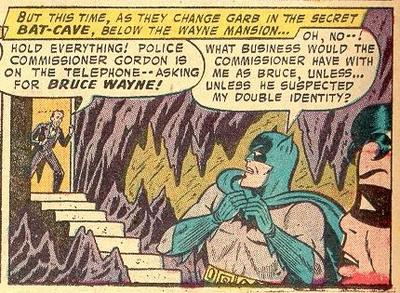
There is also a similar obvious mistake in in Batman #111. At the beginning of the story, Alfred interrupts Batman about to leave on his nightly patrol, to announce that Commissioner Gordon is calling for Bruce Wayne. Oddly Bruce acts shocked that Commissioner Gordon would call him:
Of course, the very first Batman story of all time begins with this stage setting:
The home of Commissioner Gordon, who at the moment is entertaining his young, socialite friend, Bruce Wayne.
In many stories Bruce and Commissioner Gordon were shown as friends. In Batman #71, Commissioner Gordon's Greatest Case, Gordon invites his inner circle of friends to dinner in the suspicion that one of them is Batman; among the guests are Bruce Wayne and Dick Grayson.
That same story, though, does apparently contribute the idea that Bruce Wayne was named after his father's cousin, Bruce N. Wayne, a detective "from out on the coast." The story is played somewhat as farce, as Bruce N. Wayne tries to make a real man (i.e., a detective) out of Bruce.
Another Batman of the future appears in Batman #105, "The Mysterious Bat-Missile", although this one goes unnamed. And a famous Batman foe from the past returns as a helper this time: Dr Thorne, who was known as the Crime Surgeon when he appeared in Batman #18 and Detective #77 (in which latter issue he died), pops up suddenly in Batman #106's Batman's Secret Helper as the surgeon who saved Batman's life, with no mention of his prior criminal career. Dr. Thorne would also appear in the late 1970s and again in the 1980s.
The celebrity angle continues to be played up. In Detective #244, The 100 Batarangs of Batman, thieves steal films from a Batman collector. In Batman #107, a contestant on The Big Batman Quiz goes for $125,000. In that same issue, The Career of Batman Jones tells the adventures of a crimebusting youth named after Batman. This story was foreshadowed in The Fan Mail of Danger from Batman #92, when a temporary secretary hired by Batman informs him of his namesake.
Best Stories: Detective #247 features The Man Who Ended Batman's Career. Professor Milo has come up with a way to make Batman afraid of bats, which means he can't use his equipment, such as the Batplane, Batmobile and Batarangs. He switches his double identity to become Starman, but of course that's not going to fool the Professor for long, so Robin decides to take desperate measures:

That's just a superb sequence displaying the loyalty and devotion Batman and Robin have for each other. Professor Milo would reappear a few years later and again in a classic Denny O'Neill/Neal Adams early 1970s' thriller.
Detective #248 features the terrific Around the World in 8 Days Batman must find a stolen serum in order to save a man's life. This is the third to last Dick Sprang story in Detective, and he's in fine form here with exotic locales and thrilling fight scenes.
More about →
Significant Stories: In Detective #244, we are introduced to the man who gave Batman his first Batarang and taught him how to throw it. Lee Collins was an Australian with a sideshow act throwing boomerangs. This makes the third story in as many years about the people who trained Batman in the skills he uses.
Detective #243 continues the weird transformation trend that started with #218, this time featuring The Giant Batman. Robin changes into a man again briefly in Batman #107's The Grown-Up Boy Wonder. It was still only a trickle at the time, but that was about to change.
Another trend that would prove irresistible to Batman writers began with a vengeance in Detective #250: Aliens. Batman had occasionally bumped into extraterrestials (e.g., The Manhunter from Mars, a J'onn J'onzz prototype, in Batman #78), but he was about to be inundated with them.
Batwoman returns in Batman #105. Kathy Kane had worn her old costume to a masquerade ball, but ended up helping Robin. Batman has apparently suffered amnesia, so she comes out of retirement to help the Boy Wonder. She retires again after this story, but in World's Finest #90's The Super Batwoman, Batman relents and decides to allow her to fight crime. She returns for the third time that year in Detective #249, The Execution of Bruce Wayne.
In The Secret of Batman's Butler, from Batman an early attempt at retconning is made. Alfred simply applied for the job of butler to Wayne Manor; there was no discussion about his father having worked for Thomas Wayne. In addition, he learns about Bruce's double life when Batman is injured and Robin calls him down to the Batcave. This is all wildly inconsisted with the original Alfred story in Batman #16, and most subsequent retellings (the most recent ones have him working for the Waynes before the murders).
There is also a similar obvious mistake in in Batman #111. At the beginning of the story, Alfred interrupts Batman about to leave on his nightly patrol, to announce that Commissioner Gordon is calling for Bruce Wayne. Oddly Bruce acts shocked that Commissioner Gordon would call him:

Of course, the very first Batman story of all time begins with this stage setting:
The home of Commissioner Gordon, who at the moment is entertaining his young, socialite friend, Bruce Wayne.
In many stories Bruce and Commissioner Gordon were shown as friends. In Batman #71, Commissioner Gordon's Greatest Case, Gordon invites his inner circle of friends to dinner in the suspicion that one of them is Batman; among the guests are Bruce Wayne and Dick Grayson.
That same story, though, does apparently contribute the idea that Bruce Wayne was named after his father's cousin, Bruce N. Wayne, a detective "from out on the coast." The story is played somewhat as farce, as Bruce N. Wayne tries to make a real man (i.e., a detective) out of Bruce.
Another Batman of the future appears in Batman #105, "The Mysterious Bat-Missile", although this one goes unnamed. And a famous Batman foe from the past returns as a helper this time: Dr Thorne, who was known as the Crime Surgeon when he appeared in Batman #18 and Detective #77 (in which latter issue he died), pops up suddenly in Batman #106's Batman's Secret Helper as the surgeon who saved Batman's life, with no mention of his prior criminal career. Dr. Thorne would also appear in the late 1970s and again in the 1980s.
The celebrity angle continues to be played up. In Detective #244, The 100 Batarangs of Batman, thieves steal films from a Batman collector. In Batman #107, a contestant on The Big Batman Quiz goes for $125,000. In that same issue, The Career of Batman Jones tells the adventures of a crimebusting youth named after Batman. This story was foreshadowed in The Fan Mail of Danger from Batman #92, when a temporary secretary hired by Batman informs him of his namesake.
Best Stories: Detective #247 features The Man Who Ended Batman's Career. Professor Milo has come up with a way to make Batman afraid of bats, which means he can't use his equipment, such as the Batplane, Batmobile and Batarangs. He switches his double identity to become Starman, but of course that's not going to fool the Professor for long, so Robin decides to take desperate measures:
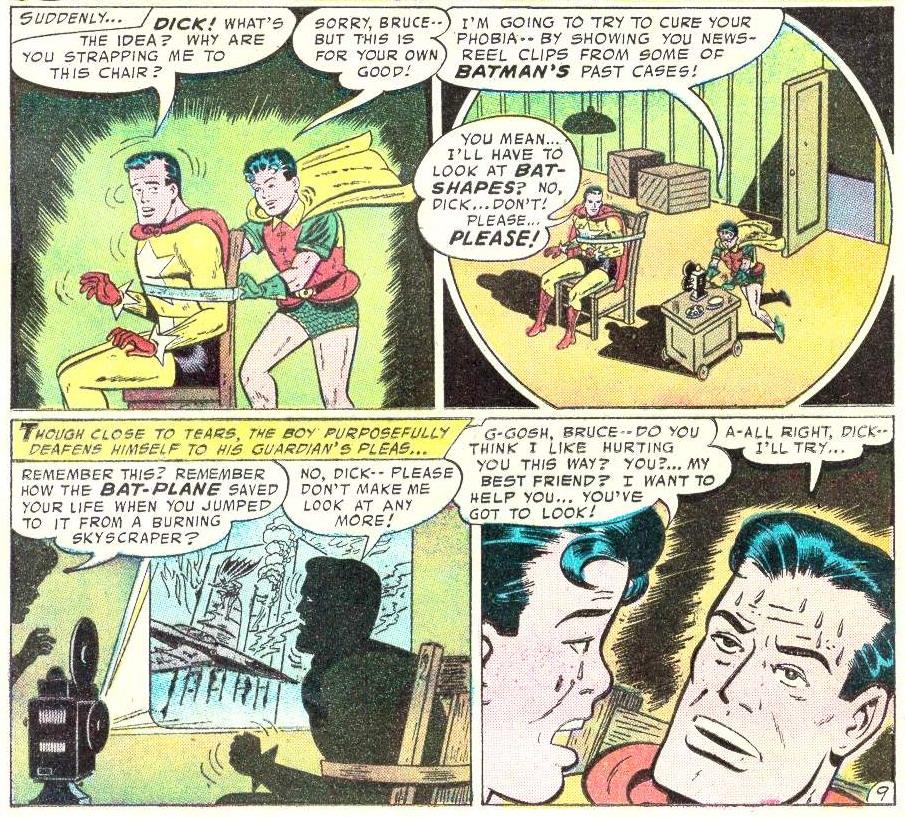
That's just a superb sequence displaying the loyalty and devotion Batman and Robin have for each other. Professor Milo would reappear a few years later and again in a classic Denny O'Neill/Neal Adams early 1970s' thriller.
Detective #248 features the terrific Around the World in 8 Days Batman must find a stolen serum in order to save a man's life. This is the third to last Dick Sprang story in Detective, and he's in fine form here with exotic locales and thrilling fight scenes.


