Number 1329: Sparky Watts, the cosmic ray kid

Người đăng: Unknown on Chủ Nhật, 10 tháng 3, 2013

In this Sparky Watts story, Sparky shrinks his way into Hubba-Hubba Land. Hubba-hubba is a term you just don’t hear any more. For those who don’t know that archaic expression, it was a way for a guy to let a babe know she was hot; a wolf-whistle and a loud “Hubba-hubba!” when she walked by.* In the forties you could even wear the expression on your belt and wallet.

Sparky Watts was given his super powers as “the world’s strongest funny man,” by cosmic rays. You remember that’s the source of the Fantastic Four’s powers, also. The FF got their powers from going into space; Sparky got his cosmic rays administered by his friend and housemate, Doc Static. But Sparky must have his cosmic rays renewed or he begins to shrink into a microscopic world. Sparky’s creator, Boody Rogers, used the idea of Sparky becoming super-small and entering a world unseen by normal-sized humans several times. It’s the plot of this funny 26-page story from Sparky Watts #6 (1947). I showed this a few years ago, but these are new scans.


*Beware, boys. Such behavior is also known as sexual harassment.
More about →

Death by Inches!

Người đăng: Unknown on Thứ Bảy, 9 tháng 3, 2013

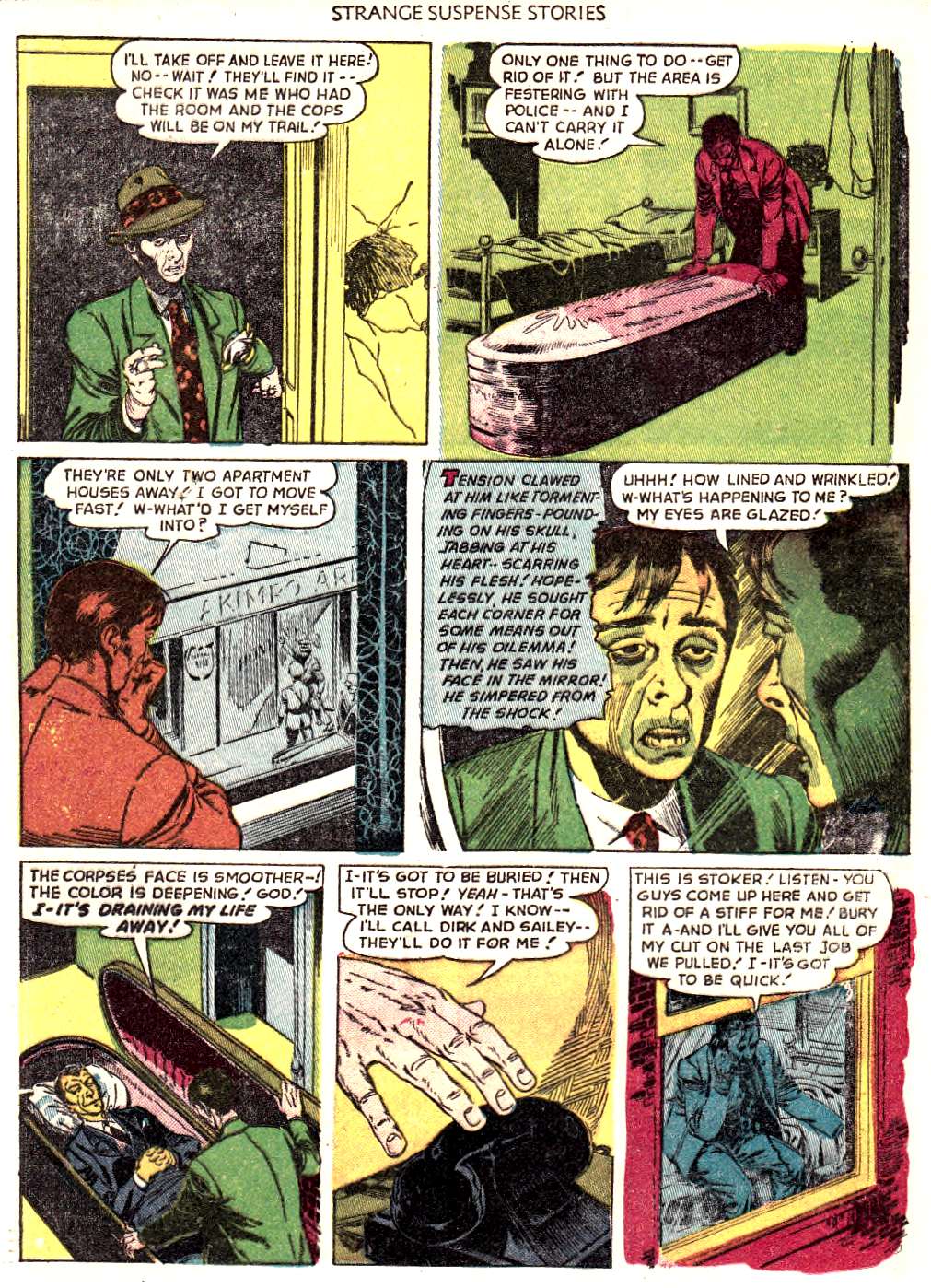
Here's the last story of the three tales featured in the August 1952 issue of Strange Suspense Stories #2 (check the archive for The Hunter Who Became the Hunted, and AIEEEEE! The Teeth!), today's eerie entry is a 10-page creeper illustrated by George Evans. Another complete issue in the bag!


More about →

Number 1328: “A whirlwind of flying fists and smoking guns!!”

Người đăng: Unknown on Thứ Sáu, 8 tháng 3, 2013

Black Cat is really Linda Turner, Hollywood movie star, who has nothing to do when not filming but go around in costume fighting bad guys. As a member of the “Evacuation Corps,” Linda goes on a short mission to buy a ranch to keep children safe in case the war comes to California. Naturally, the owner refuses (it isn’t as if Linda asked him; it was more of a demand), and that lack of patriotism gets Black Cat involved. Although Linda tosses in a gratuitous personal insult and seems high-handed in her treatment of the ranch owner, it turns out the guy is in a with a ring of saboteurs. So, owing to the temper of the times, he deserves to get his butt kicked all the way to Berlin. The story, drawn by Arthur (Arturo) Cazeneuve, is from Harvey’s Speed Comics #22 (1942).

This is our last day of Pappy's “War is hell on the homefront” week. All of our stories this week have been from comic books published in 1942, and the subject is the war against saboteurs fought on American soil. I want to continue this theme in the future.


More about →

Number 1327: Instant boy to man

Người đăng: Unknown on Thứ Tư, 6 tháng 3, 2013

Our third day of Pappy's “War is hell on the homefront week” takes us from England to the United States. Young, weak, bullied Arthur Lake, son of an American aircraft manufacturer, is visiting that country with his dad, when he stumbles into a cave and discovers — ta da! — King Arthur’s sword embedded in stone. Arthur pulls it out and becomes the Sword. Not King Arthur. In 1942 in comics, superheroes, not a king, were the thing. As with our other stories this week, sabotage is what our hero is out to stop.

This is from the one-and-only issue of Ace Publications’ Captain Courageous, #6. The Sword went on in Super-Mystery Comics for a time. My observation on such characters who go instantly from boys to men is that they were to appeal to youngsters who with a bit of magic could become all those things they weren't, big and strong. That would include having maturity, also, I assume. It’s a great fantasy. I say maturity because at the end of the story Arthur decides he can’t be the Sword all the time. And why not? Well, he doesn't say it, but for one thing he’d have to get a job. That takes a certain amount of maturity to know that is a whole other thing from being a superhero. Had I those powers when I was young Arthur's age the temptation for me would be to stay that big man and tell my mom, “No, Ma, I won’t eat broccoli. What are you gonna do about it?” or, “Go to bed? How are you gonna make me?”


More about →

Julius Schwartz Builds an Empire

Người đăng: Unknown on Thứ Ba, 5 tháng 3, 2013

In early 1959, Whitney Ellsworth's name finally disappeared as editor from the indicia of every DC comic. It is well-established that he had actually ceased working in New York by the early 1950s, instead pitching DC's properties to Hollywood and the TV studios.

When the real editors were revealed, Julius Schwartz had a rather modest portfolio.  He was responsible for DC's two science-fiction series, Strange Adventures and Mystery in Space, giving him responsibility for 20 comic books a year, as SA was a monthly and MiS appeared eight times a year.

But when the Flash was added to his titles early that year, he boosted his production to 26 books (Flash started out as a bi-monthly).  Green Lantern started appearing every other month in mid-1960, and the Flash was promoted to eight times a year, so now Schwartz was editing 34 books per annum.  Briefly, because in late 1960 the Justice League of America began appearing, giving him the reins over 40 issues annually.

By the beginning of 1962, Green Lantern and JLA had been bumped up to eight issues a year, giving Schwartz responsibility for 44 comics per year.  But that didn't last long, as the Atom got his own title midway through that year, putting Schwartz at 50 issues per solar orbit.  The Flash got an annual in 1963 putting the number of Schwartz comics at 51. 

Hawkman took awhile to win his wings as I have discussed in the past, but that gave Schwartz briefly 57 comics per annum. In May of 1964, Schwartz was handed responsibility for Detective and Batman, although in return he was relieved of Strange Adventures and Mystery in Space, the two titles he had at the beginning of his empire-building.  Although the swap seemed even up with Detective having as many issues as SA, and Batman an equal amount as MiS, Batman did have the Summer and Winter Annuals, ticking Schwartz up to 59 books annually.  Correction: As noted in the comments by Christoph Melchert, Jack Schiff continued editing the Batman Annuals for awhile; he is credited in those issues up until Batman #198 when Nelson Bridwell took over.  Schwartz did get credit for editing Batman #176; I am not sure if that is just a mistake or what.

That's a pretty hefty workload, especially when you consider that in addition to editing, Schwartz also wrote the filler for his books (unlike many of the other editors, who used Henry Boltinoff's gag strips).  Flash had Flash Facts and Amazing Speeds, while for Green Lantern Schwartz gave vocabulary lessons with "What's the Difference" and imitated Ripley with "It's Hard to Believe, But..."

After that Schwartz's workload stayed relatively stable.

Update: Martin O'Hearn points out in the comments that Schwartz did have a few other titles in his stable as of 1959.  Western Comics and All-Star Western were both published until 1961, and the last few issues of Rex the Wonder Dog and Hopalong Cassidy (both cancelled in mid-1959) bear his name on the indicia.  Good catch, Martin!

This also brings up another interesting point.  Who worked on those last couple of issues of Rex?  John Broome did the writing chores; guess who became the main writer on the Flash?  And Carmine Infantino did the Detective Chimp backup series in those comics; he became the penciller on the Flash.  Gil Kane did the pencils on Rex and Hopalong; he did the same for Green Lantern and (eventually) the Atom.  I haven't taken a hard look at it, but I suspect that when Rex and Hoppy were cancelled, Kane suddenly started doing a lot more stories in Strange Adventures and Mystery In Space until GL and the Atom filled up his schedule.

In other words, what in isolation may appear like x comic was cancelled and (completely unrelated) y comic was started may simply have been a reallocation of existing resources.  Remember, all these creative talents were making a living working for the individual editors at DC, and there was no particular reason to furlough them just because a genre (like westerns) happened to go out of vogue.  As well, recall that DC was remarkably consistent in terms of the number of comics it put out during the Silver Age.  They basically put out 360 comics a year, every year.  That number might vary widely by genre, as I have discussed in the past, but it stayed right around 360.  Therefore, they still needed the same amount of script and artwork done every year.
More about →

The Hunter Who Became the Hunted!

Người đăng: Unknown

You already know how it's going to end when delving into precode horror tales about hunters-- but half the fun is of course getting there-- and yes, this one is pretty fun. GCD says this is Lou Cameron art, what's everyone think? From the August 1952 issue of Fawcett's Strange Suspense Stories #2.


More about →